 blog
blog
Buy Custom Printed Promotional Products Online
Table of Contents
- Why Custom Printed Promotional Products Matter for Brand Building
- Screen Printing vs Embroidery for Branding: Which Method Fits Your Goals
- Bulk Screen Printed Apparel: Maximizing ROI on Corporate Orders
- Promotional Product Design Best Practices for Logo Impact
- Ensuring Color Accuracy and Brand Consistency Across Orders
- Turnaround Times, Setup Fees, and What to Expect When You Order
- How to Get Started: Preparing Files and Requesting Your Quote
- Frequently Asked Questions
Last Updated: September 20, 2026
Why Custom Printed Promotional Products Matter for Brand Building
Custom printed promotional products have become essential for businesses looking to strengthen brand identity and create lasting impressions. Whether you're launching a new campaign, attending a trade show, or building customer loyalty, these items serve as tangible reminders of your brand that recipients use repeatedly. Promotional products aren't just giveaways, they're strategic marketing investments that keep your brand visible long after initial contact.
Many companies order from multiple vendors, resulting in inconsistent colors, logos, and quality across batches. This fragmentation undermines brand consistency and wastes marketing dollars on items that don't represent your business properly.
Screen Printing vs Embroidery for Branding: Which Method Fits Your Goals
Screen printing and embroidery each bring distinct advantages to promotional apparel, and the right choice depends on your design, budget, and durability needs.
Screen printing forces ink through a mesh screen onto fabric, excelling for bold, multi-color designs with vibrant, crisp results. Per-unit costs decrease significantly with larger quantities, making screen printing ideal for bulk orders. The process handles fine details well and produces colors that remain vivid through repeated washing.
Embroidery stitches thread directly into fabric to create raised, textured logos that convey premium quality and durability. Embroidered items withstand heavy use and laundering without fading, but work best for simpler designs with fewer color changes and carry higher per-unit costs even at scale.
Bulk Screen Printed Apparel: Maximizing ROI on Corporate Orders
Bulk screen printed apparel represents one of the highest-ROI promotional investments when you understand the financial mechanics and brand impact metrics that matter.
The Cost-Per-Unit Advantage
Setup fees remain constant regardless of quantity, so per-unit costs drop dramatically as order volume increases. Setup fees remain constant regardless of quantity, so per-unit costs drop dramatically as order volume increases. This is why bulk orders make financial sense for companies distributing at events, to employees, or as customer appreciation gifts.
Measuring Brand Recall and Engagement
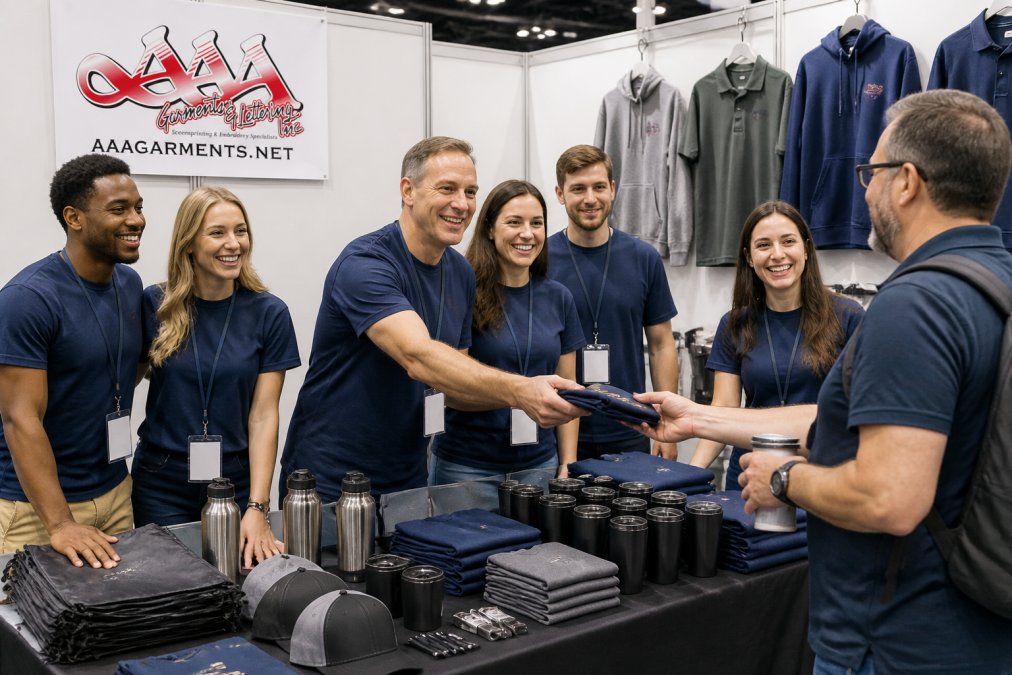
Bulk screen printed apparel creates consistency, every item carries your logo in the same colors, positioned identically. This uniformity strengthens brand recognition and prevents fragmentation from multiple vendors. AAA Garments & Lettering, Inc. ensures your logo maintains the same appearance across reorders.
The key metric is frequency of use: a t-shirt worn weekly generates far more brand exposure than one worn once a year.
Before ordering, define success. Are you measuring:
- Brand awareness? Track whether recipients can recall your company name and logo weeks after receiving the item.
- Customer retention? Monitor whether customers who received promotional items make repeat purchases at higher rates.
- Event attendance or lead generation? Count how many people visit your booth or contact you after receiving branded apparel at a trade show.
- Employee engagement? Assess whether employees wearing company apparel report stronger connection to company culture.
Calculating True ROI
Bulk orders matter because lower per-unit costs can make it easier to achieve positive ROI even if only a small percentage of recipients convert.
Real ROI emerges when recipients wear these items. A company t-shirt worn at a gym, conference, or around town becomes mobile advertising, generating repeated brand exposure over months or years.
Reorder Strategy and Long-Term Value
Bulk orders create opportunities for reordering at consistent pricing. Once you've established a design and supplier relationship, future orders become faster and cheaper because setup fees are already absorbed, maintaining brand consistency across campaigns and years.
Promotional Product Design Best Practices for Logo Impact
Your logo's success on promotional products depends on thoughtful design preparation and understanding how different sizes and placements affect visibility and brand impact.
Start with vector artwork. Logos created in vector format scale infinitely without losing sharpness, ensuring crisp reproduction at any scale, from t-shirt front to hat thumbnail (EPS vs. SVG: What are the differences?). If you only have a raster logo, professional vector recreation is a worthwhile investment for consistent branding.
Simplify for small sizes. When logos shrink to fit small items like pens or keychains, fine details disappear. Test your design at actual reproduction sizes and consider a simplified version for space-limited items to ensure your brand remains recognizable.
Color matters more than you think. A logo that looks perfect in full color might become unreadable when printed in single-color on apparel. Plan for both color and single-color versions to maintain impact.
Placement and positioning affect perceived quality. AAA Garments & Lettering, Inc. guides clients through these decisions to ensure designs translate beautifully to actual products.
Ensuring Color Accuracy and Brand Consistency Across Orders
Color consistency ranks among the top concerns businesses raise before ordering promotional products. The solution starts with Pantone color matching. Pantone is the industry standard for color specification. Instead of describing a color as "navy blue," you specify it as Pantone 281 C. This removes guesswork and ensures your color remains consistent across orders, vendors, and time.
Before placing a large order, request a proof approval, a sample showing your exact design on your exact product in your exact colors. Review it in natural light to catch color or placement issues before production, preventing costly reprints.
Document your color specifications. Keep records of which Pantone colors you used for each product type. When you reorder months later, you have the exact reference. This eliminates "we want that same yellow from last time" conversations that lead to mismatches.
Turnaround Times, Setup Fees, and What to Expect When You Order
Understanding timelines and costs prevents surprises and helps you plan promotional campaigns effectively.
Lead time depends on order quantity, design complexity, production queue, and shipping distance. Planning 3-4 weeks ahead balances cost efficiency with reasonable timelines and allows for design refinement and proof approval without rush charges. Setup fees cover screen creation or embroidery machine programming, one-time costs per design. Request a detailed quote showing setup fees separately from per-unit costs so you understand exactly what you're paying for.
How to Get Started: Preparing Files and Requesting Your Quote
File Format and Technical Specifications
Ideal files are vector-based (Adobe Illustrator .AI, .EPS, or PDF vector format), which scale infinitely without losing sharpness. Provide your logo in the highest-quality format available. For screen printing, provide artwork at 100% of the intended print size whenever possible so the designer and printer understand exactly how fine details will render.
Color Specification: Beyond "Navy Blue"
Provide Pantone numbers (specify coated C or uncoated U surfaces) or a color reference like brand guidelines or a website screenshot. For screen printing, solid, saturated colors are straightforward; metallic, fluorescent, or pastel colors require specialty inks and may cost more. Discuss color complexity with your provider during the quote phase.
Proof Approval: Your Quality Control Checkpoint
Before placing a large order, request a proof approval. A proof is a sample showing your exact design on your exact product in your exact colors. Review it in natural light, not just on a screen. If the color isn't right, you catch it before production. If the logo placement looks off, you fix it now. If the design size is too large or too small, you adjust it. This step prevents costly reprints and ensures your promotional products match your brand standards.
Don't skip proof approval for budget reasons. The cost of a proof sample is negligible compared to the cost of reprinting items with the wrong color or placement.
Gathering Your Information Before You Quote
Logo and design files: Provide your logo in the highest-quality format available.
Requesting a Detailed Quote
Contact AAA Garments & Lettering, Inc. and provide your specifications. A complete quote should show:
- Setup fees (one-time cost per design)
- Per-unit cost (materials and labor)
- Total price for your quantity
- Estimated lead time
- Available decoration methods (screen printing, embroidery, or both)
- Any color-matching or specialty-ink charges
Document Everything for Future Orders
Once you've placed your first order, keep detailed records:
- Final approved design file (vector version if it was recreated)
- Pantone color numbers used
- Product specifications (brand, style, size range)
- Proof approval photos
- Supplier contact information
Frequently Asked Questions
How do you ensure color accuracy when I reorder custom printed promotional products months later?
Color consistency across orders requires professional color matching and documentation from your first order. We use Pantone color standards and maintain proof records so your brand colors stay true whether you reorder in weeks or months. Your design file and approved proof become your reference, eliminating guesswork on future orders. This is why working with experienced vendors who track your specifications matters, it prevents the mismatches you've experienced before.
What file formats do you need for custom logo printing on promotional products?
Vector artwork (AI, EPS, or PDF) works best for sharp, scalable logos at any size. High-resolution raster files (300 DPI PNG or JPG) work for detailed images. If your logo isn't print-ready, our design team can help prepare it properly so your brand looks professional on every item. Don't worry if you're unsure, send what you have and let us guide you through the process.
What's the typical turnaround time for custom screen-printed apparel orders?
Turnaround depends on order size, complexity, and current production schedules. Smaller orders may be faster than large bulk runs. We provide specific lead times once you request a quote and confirm your design. Rush options are often available if you have a tight deadline. Contact us directly with your timeline so we can guarantee we can meet it before you commit.
Are there minimum order quantities for custom promotional products?
Minimum order quantities vary by product type and decoration method. Screen printing typically has lower minimums than some other methods, especially for apparel. Bulk orders unlock better pricing and faster per-unit costs. Request a quote with your specific needs and quantities to learn the exact minimums and pricing for your project.